

Strolling the neighborhood on Halloween while pregnant isn’t about heroics. It’s about understanding what your body is doing right now and managing the load accordingly.
I’ve worked with expecting mothers in Mesa for over fifteen years. Every October, the same pattern shows up in my practice: sharp sacroiliac joint pain the day after trick-or-treating. Lower back fatigue that wasn’t there before the candy walk. Pelvic discomfort that makes getting out of bed difficult the next morning.
This isn’t random. Your body is in a state of intentional structural looseness. The hormone relaxin is actively softening the ligaments that hold your pelvis together. According to the Cleveland Clinic, this hormonal shift causes the sacroiliac joints, the large joints connecting your hip bones to your sacrum, to widen and rotate in preparation for childbirth. When those joints lose their passive stability, the muscles surrounding them have to compensate. Walking for extended periods on hard, uneven surfaces compounds that stress.
The American College of Obstetricians and Gynecologists confirms that back pain is one of the most common physical challenges during pregnancy. It’s not a rite of passage. It’s a signal that your structure is being loaded beyond its current capacity to stabilize.
Here’s the thing: you can participate in Halloween. You just need to prepare your body for the specific demands of the evening. That means footwear with real arch support. A maternity support belt positioned correctly on your hips. A flat, well-lit route with planned rest intervals. And the discipline to sit down before you feel like you need to.
Maintenance beats rescue. Always.
Key Takeaways
- Relaxin Hormone Impact: Pregnancy hormone relaxin intentionally softens pelvic ligaments, causing sacroiliac joints to widen and forcing surrounding muscles to compensate with constant stabilization during walking.
- Center of Gravity Shift: Growing babies shift center of gravity forward, increasing lumbar lordosis and forcing lower back muscles into continuous isometric contraction that creates overuse pain, not simple fatigue.
- Standing Duration Risk: A 2025 PubMed study found pain intensity significantly higher when pregnant women stand versus lie down; prolonged standing creates cumulative stress on lumbar spine and pelvic joints.
- Sharp Pain Mechanism: Unilateral sharp pelvic pain when stepping indicates sacroiliac joint dysfunction from hypermobile joints shifting under load, requiring professional chiropractic alignment rather than rest alone.
- Support Belt Function: 2019 systematic review confirms maternity support belts provide mechanical stabilization by compressing joint spaces and restricting unwanted hypermobility during physical activity like trick-or-treating.
How Can I Stay Comfortable While Trick-or-treating Pregnant?
Pregnant women can stay comfortable while trick-or-treating by managing biomechanics and incorporating rest intervals. Wearing supportive shoes with proper arch support is essential, as pregnancy hormones loosen pelvic ligaments. Taking frequent breaks prevents stabilizing muscle fatigue, and choosing routes with even pavement reduces strain on already-compromised joints and balance.
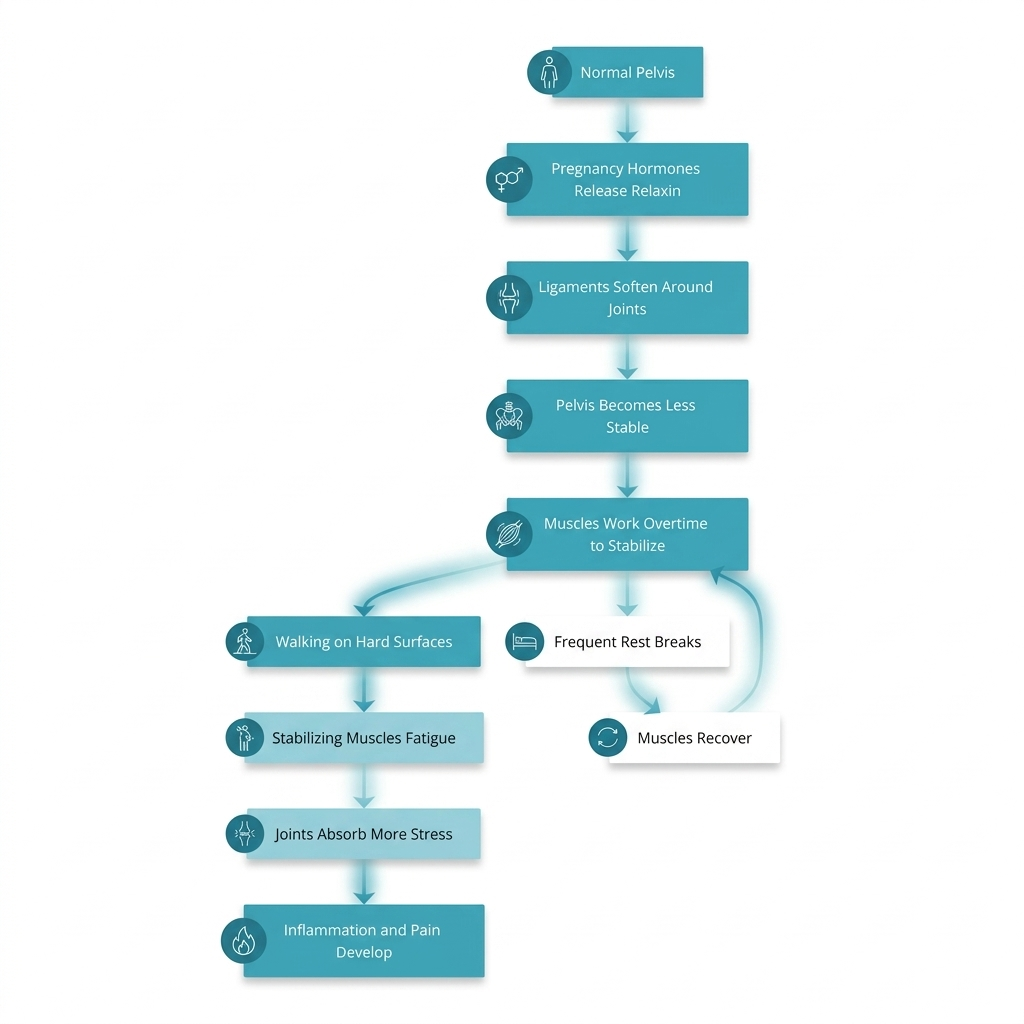
The Biomechanical Reality of Walking on Halloween Pregnant
Your pelvis is not a fixed structure right now. It’s a dynamic system held together by ligaments that are intentionally being softened to allow for birth. That’s a good thing when it comes time to deliver. It’s a challenging thing when you’re trying to walk several blocks behind a slow-moving toddler.
The sacroiliac joints are among the largest in your body. They connect the ilium bones of your pelvis to the sacrum at the base of your spine. Every time your hips move, those joints are engaged. During pregnancy, relaxin loosens the connective tissues around those joints. The Cleveland Clinic notes that this widening and rotation can lead to sacroiliitis, inflammation of the sacroiliac joint, especially after prolonged walking or asymmetrical loading.
Think of your pelvis like a suspension bridge. Normally, the cables and supports are taut and predictable. Relaxin loosens those cables. The bridge still works, but it requires constant muscular tension to keep it from swaying. When you walk for an hour on concrete sidewalks, those stabilizing muscles fatigue. When they fatigue, the joints themselves absorb more stress. When the joints absorb more stress, you get inflammation and pain.
Think of It This Way
Think of your pelvis right now like a wooden chair whose glue has been deliberately loosened: the joints still fit together, but the frame relies on the person sitting in it to hold steady, using constant tension in their legs and core to keep the chair from wobbling. Pregnancy hormones soften the ligaments that normally lock those pelvic joints tight, preparing your body for birth. That softening is necessary, but it means the muscles around your pelvis have to work overtime every time you take a step, gripping harder to keep the structure stable. Walk for an hour on concrete sidewalks and those stabilizing muscles tire out the same way your arms would if you’d been holding that wobbly chair together with your hands. When the muscles fatigue, the joints themselves absorb more of the load, and that extra stress shows up as discomfort. You are not fragile, you are working harder to hold yourself together with every step you take.
Mesa sidewalks are not forgiving. Cracked pavement, uneven curbs, and sudden transitions from concrete to grass all require your body to adjust its stabilization strategy in real time. Your proprioception, your body’s sense of where it is in space, is already compromised because your center of gravity has shifted forward and upward. Think of it like the internal map your brain uses to know where your hand is without looking, or how you can walk without staring at your feet: millions of tiny sensors in your joints and muscles constantly report their position, and right now that reporting system is working with outdated coordinates. Adding poor lighting and costume shoes with no arch support creates a perfect environment for missteps and compensatory strain.
The CDC recommends that healthy pregnant women engage in at least 150 minutes of moderate-intensity aerobic activity per week, including brisk walking. Halloween walking is absolutely safe when biomechanics and rest intervals are properly managed. Biomechanics is how the moving parts of your body work together under load, the same way an engineer studies how a loaded shopping cart rolls: which wheels bear the weight, which joints swivel, and what happens when the ground isn’t flat. The issue is not the walking itself. The issue is unplanned, extended walking on hard surfaces without adequate structural support.
You’re not fragile. You’re structurally altered. Those are different problems requiring different solutions.
How Does a Pregnant Woman’s Center of Gravity Shift Affect Her Spine?
As the baby grows, a pregnant woman’s center of gravity shifts forward, causing the lower back to increase its inward curve (lumbar lordosis) to maintain balance. This postural compensation places chronic stress on the facet joints and forces the lumbar spine muscles into constant contraction to prevent forward tipping, leading to overuse and pain.
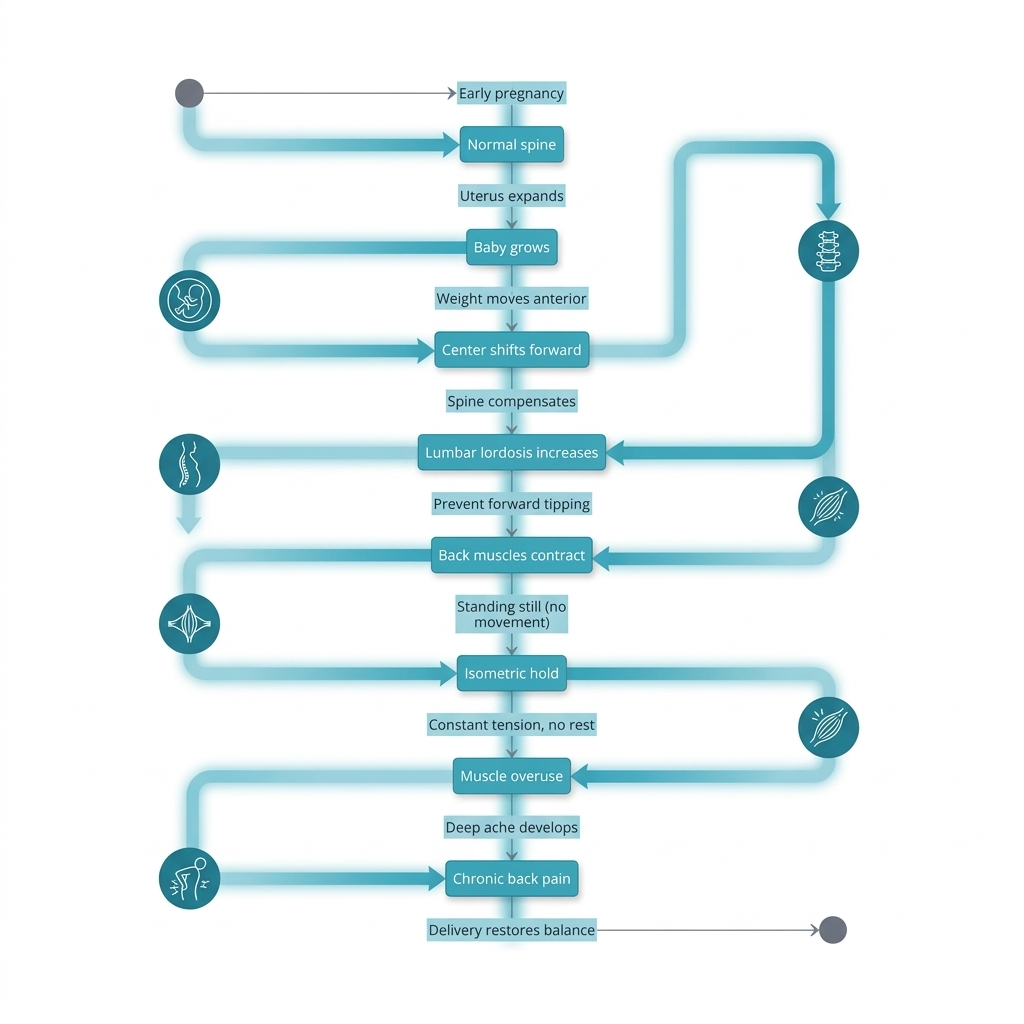
Center of Gravity, Anterior Pelvic Tilt, and the Pregnancy Sway
As your baby grows, your body’s center of gravity shifts forward. To compensate, your lower back increases its inward curve—what we call lumbar lordosis. That’s the sway-back posture you see in late pregnancy: the low back arches inward more than usual, like a suspension bridge cable that has to dip deeper to hold a heavier load in the middle. This is a normal postural adaptation. It’s also a chronic stressor on the facet joints and muscles of your lumbar spine.
What This Means for You
Picture a flagpole on a windy day: the pole itself stays vertical, but only because the guy wires on the back side pull tight and hold steady against the wind’s forward push. Your spine is that pole, your baby is the wind leaning you forward, and the muscles along your lower back are those guy wires, tensed and straining every moment you stand. The wires never get to go slack. They hold the same taut line while you wait at the door, while you shuffle down the sidewalk, while you stand in one spot handing out candy. That constant pull, hour after hour with no break, is what creates the overuse, the deep ache that arrives not because you lifted something heavy, but because those muscles never got permission to rest.
Stand in front of a mirror right now. Look at your profile. Notice the curve in your lower back. That curve is doing real mechanical work to keep you upright. The muscles along your spine, particularly the erector spinae and quadratus lumborum, are contracting constantly to prevent you from tipping forward.
Now imagine standing on a concrete driveway for two hours handing out candy. You’re not walking, so you don’t get the momentum of a normal gait to distribute the load. You’re just standing. Your lower back muscles are locked in isometric contraction the entire time. Think of holding a plank position during exercise: your abdominal muscles are working hard even though nothing is moving. An isometric contraction means the muscle is generating force to hold a position, not to create motion, like a rope pulled tight between two posts. That’s not fatigue. That’s overuse.
A 2025 study published in PubMed found that pain intensity among pregnant women was significantly higher when standing compared to lying down. Prolonged standing creates cumulative stress on the lumbar spine and pelvic joints. A 2015 literature review confirmed that prolonged standing is associated with lower back and leg pain, fatigue, and adverse pregnancy outcomes.
Here’s what happens during a typical Halloween night: You stand to hand out candy for an hour. Then you walk slowly behind your child for another hour. The standing locks your lower back into a static contraction. The slow walking prevents the normal heel-strike momentum that helps distribute force through your kinetic chain. You’re combining two of the worst postural scenarios for a pregnant spine.
The anterior pelvic tilt also changes how your hips extend during walking. Normally, your hip extends backward as you push off with your foot. When your pelvis is tilted forward, that extension is restricted. Your glutes can’t fire properly. Your hamstrings have to compensate. Your lower back has to compensate. By the time you get home, everything from your mid-back to your knees is fatigued.
This is not a character flaw. This is physics.
What Causes Sharp Pelvic Pain When Taking a Step During Pregnancy?
Sharp pelvic pain when stepping during pregnancy occurs when pregnancy hormones like relaxin loosen the sacroiliac joints, reducing their passive stability. Fatigued stabilizing muscles struggle to support these hypermobile joints during sudden movements like pivoting or stepping off curbs. This causes the joint to shift slightly, triggering protective muscle spasms and acute sacroiliac joint dysfunction rather than muscle strain.
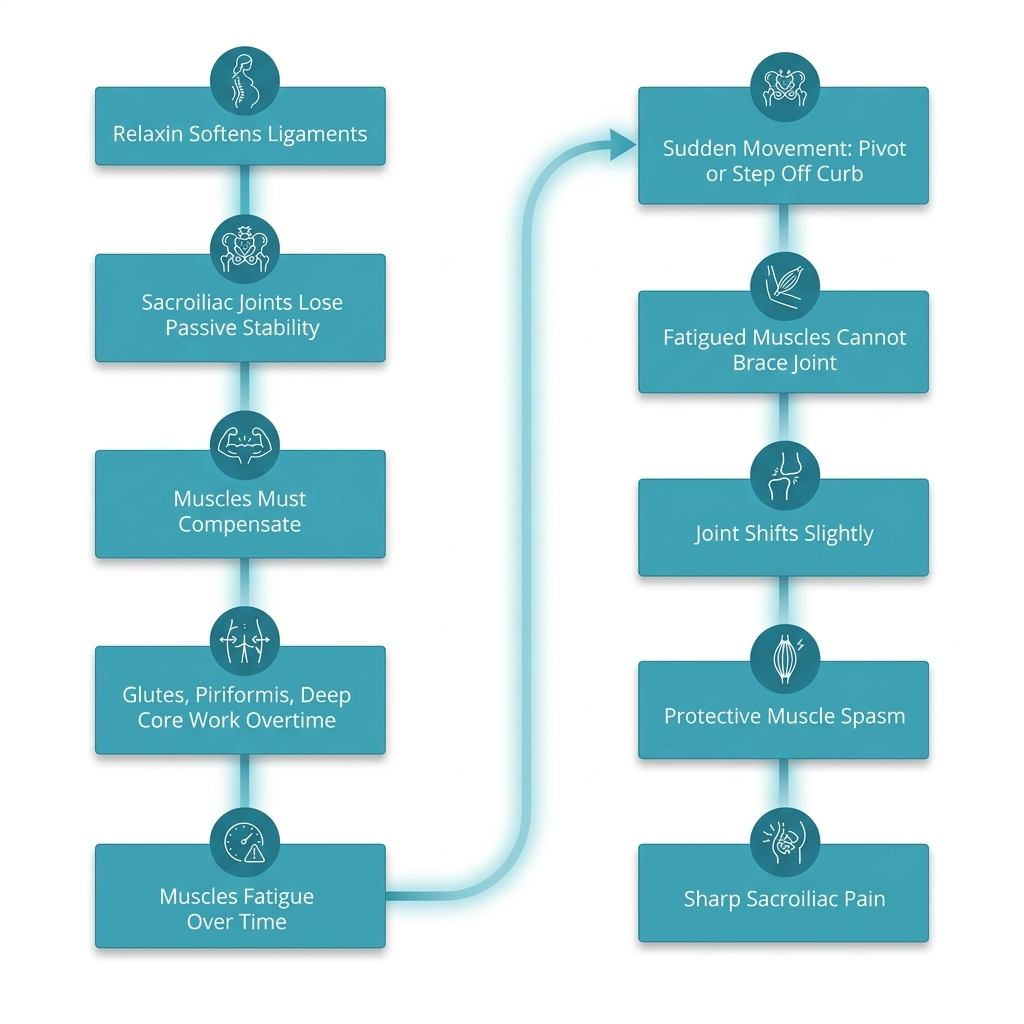
Ligamentous Laxity and Sacroiliac Joint Pain Relief
Because relaxin reduces the passive stability of your pelvic joints, your muscles are now responsible for stabilizing structures that used to stabilize themselves. Relaxin is a hormone your body releases during pregnancy that softens the ligaments holding your joints together, the way a warm rain loosens packed soil: the structure is still there, but it gives more easily under pressure. The gluteals, the piriformis, the deep core muscles—they’re all working overtime.
The Simple Version
Think of a backyard gate that’s always hung steady on its hinges: for years, the metal pins and the frame itself held everything square without you thinking about it. Then one season the wood swells, the screws loosen, and suddenly that gate only stays shut because you’re leaning your shoulder against it every time the wind picks up. Your shoulder wasn’t designed to be a hinge, but now it has to be.
That’s what happens when pregnancy hormones loosen the ligaments around your sacroiliac joints. The joints used to stabilize themselves: the ligaments were the hinges, doing their work passively, all day, without effort. Now those ligaments have softened, and your muscles step in to hold everything in place. Your glutes, your deep core, the small stabilizers around your pelvis: they’re all leaning against that gate now, and they get tired. When you pivot fast to catch your toddler or step off a curb in the dark, you’re asking fatigued muscles to brace a joint that no longer braces itself. That’s when the joint shifts slightly, the muscles around it tighten to protect it, and you feel that sharp catch in your lower back or buttocks.
When you step off a curb awkwardly in the dark, or pivot suddenly to catch a running child, you’re asking those fatigued muscles to stabilize a joint that has very little passive restraint. That’s when you get the sharp, pinpoint pain in your lower back or buttocks. That’s sacroiliac joint dysfunction.
The Cleveland Clinic describes this as a stabbing pain that occurs when the sacroiliac joints widen and rotate under load. It’s not a muscle strain. It’s joint irritation. And it doesn’t respond to stretching or massage the way muscle pain does. It responds to stabilization and proper alignment.
Here’s what that looks like in real terms: You’re walking down the street. Your toddler runs ahead. You pivot on your right leg to follow. Your left sacroiliac joint, which is already loose, shifts slightly out of its normal position. The muscles around it spasm to protect it. You feel a sharp catch. The next morning, you can’t roll over in bed without pain.
This is a common presentation. I see it every November in my practice. The solution is not rest alone. The solution is restoring proper joint alignment and giving the joint external support so the muscles don’t have to work as hard.
A systematic review published in PubMed Central in 2019 found that maternity support belts provide mechanical stabilization by gently compressing joint spaces. This restricts unwanted hypermobility in the sacroiliac joint and helps alleviate lower back pain and pelvic girdle pain during physical activity.
The belt doesn’t replace your muscles. It assists them. Think of it like a brace on a wobbly table leg. The table still needs to be structurally sound, but the brace prevents it from wobbling while you fix the underlying issue.
Why Does Carrying Weight on One Hip Cause Sacroiliac Joint Strain During Pregnancy?
Carrying weight on one hip during pregnancy creates lateral spinal flexion, hip hiking, and sustained muscle contraction that loads the sacroiliac joints asymmetrically. This rotational stress is particularly problematic because pregnancy hormones already make these joints hypermobile. The combination of asymmetric loading and existing joint laxity leads to inflammation and acute sacroiliac pain.
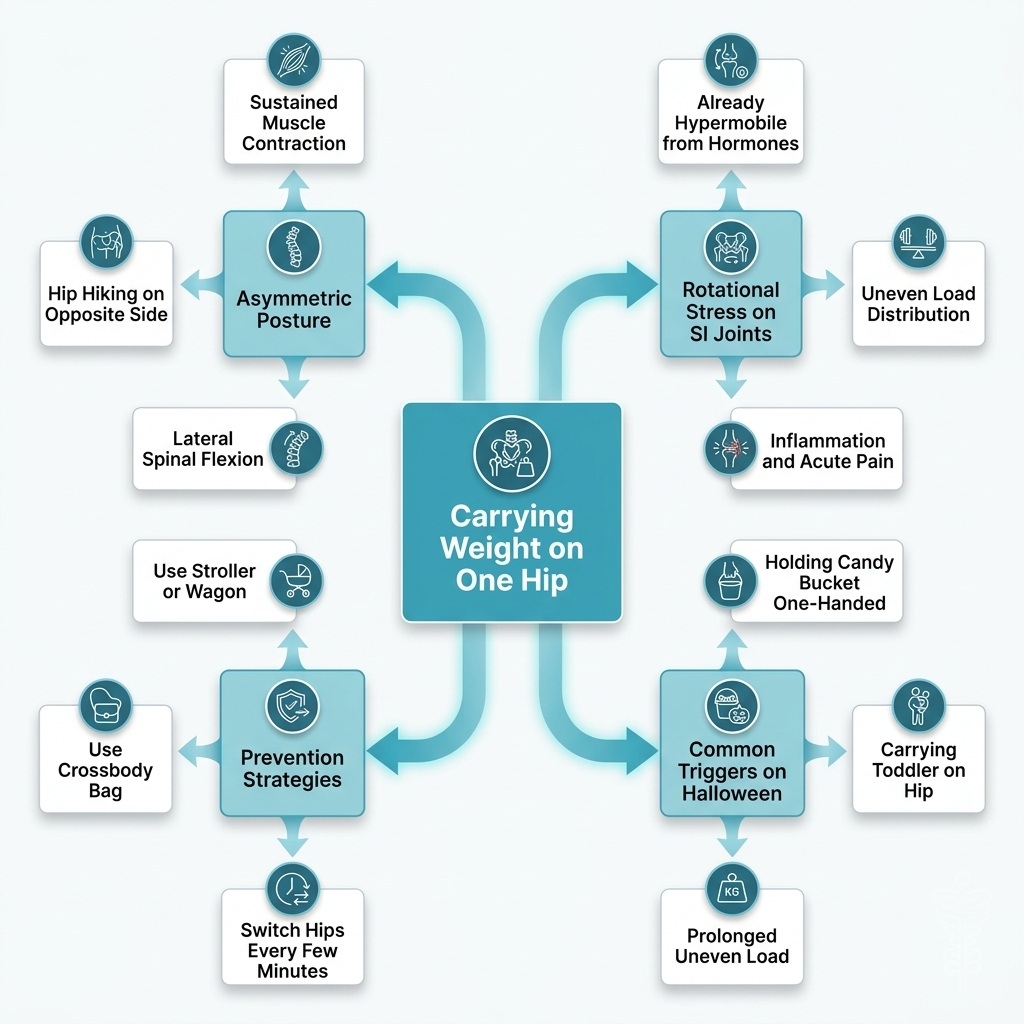
Asymmetric Loading and Carrying Mechanics
Carrying weight unevenly is one of the fastest ways to destabilize your pelvis during pregnancy. When you carry a toddler on your left hip, your spine flexes laterally to the left. Your right hip hikes up. Your right quadratus lumborum and your left hip abductors are both in sustained contraction. Your sacroiliac joints are loaded asymmetrically.
Do that for ten minutes, and you’ll feel fatigue. Do it for an hour, and you’ll wake up the next morning with acute right-sided sacroiliac joint pain.
The Cleveland Clinic confirms that the sacroiliac joints are engaged every time the hips move or shift. Asymmetrical loading creates rotational stress on joints that are already hypermobile. This is not a strength issue. This is a leverage issue.
On Halloween, you’re carrying candy buckets, holding your child’s hand, and possibly carrying an exhausted toddler by the end of the night. Every one of those activities creates asymmetrical load. If you’re not conscious of how you’re distributing that weight, you’re setting yourself up for a rough morning.
The solution is simple but requires discipline: carry weight symmetrically whenever possible. Use a crossbody bag instead of a shoulder bag. Use a stroller or wagon for the candy bucket. If you have to carry your child, switch hips every few minutes. If your partner is with you, hand the child off regularly.
This sounds trivial. It’s not. Small, regular habits prevent big, painful problems.
How Can I Make My Pregnant Halloween Costume More Supportive for My Back?
Choose costumes that allow full hip extension and unrestricted forward steps to prevent gait inefficiency and lower back compensation. Ensure the fabric permits deep breathing and bending at the hips. Pair the costume with structured footwear featuring arch support and shock-absorbing midsoles to prevent arch collapse and pelvic destabilization, which directly impacts back strain during extended wear.
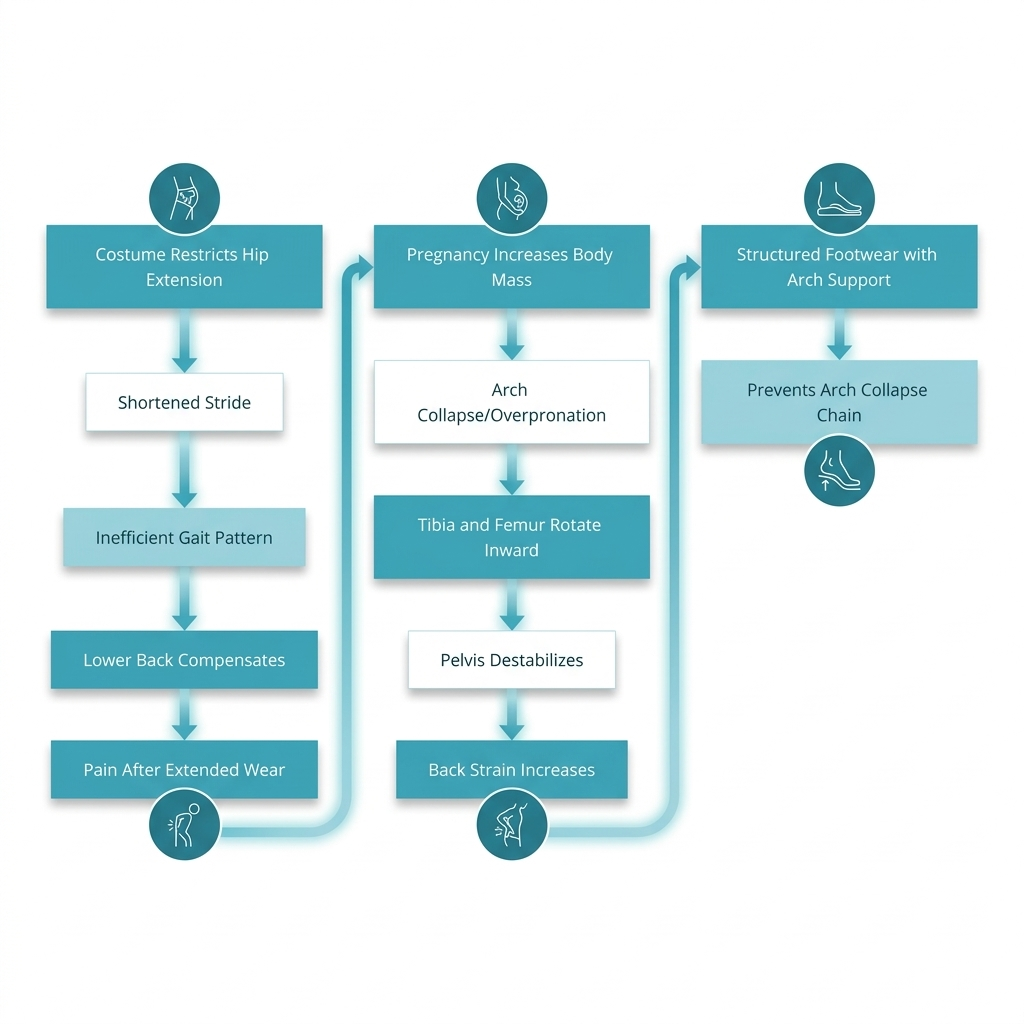
Pregnant Halloween Safety: Costumes, Footwear, and Route Planning
Your costume matters. Not because of aesthetics, but because of mechanics.
If your costume restricts hip extension, you will shorten your stride. If you shorten your stride, your gait becomes inefficient. Gait is your walking pattern: how your feet, knees, hips, and spine move together as you take each step. If your gait becomes inefficient, your lower back has to compensate. If your lower back compensates for an hour, you will have pain.
Look at your costume. Can you take a full step forward without the fabric pulling? Can you bend at the hips to pick something up? Can you breathe deeply without restriction? If the answer to any of those questions is no, modify the costume or choose a different one.
Footwear is non-negotiable. Pregnancy increases your body mass and reduces the passive stability of your arches. The Cleveland Clinic notes that pregnancy is a primary risk factor for developing overpronation—flattened arches. Think of your foot like a bridge: the arch is the curved span in the middle that normally stays lifted off the ground. Overpronation means that arch has flattened down, so the inside edge of your foot rolls inward when you walk, and the whole structure loses the spring it’s supposed to have. When your arches flatten, your tibia and femur rotate inward. That internal rotation destabilizes your pelvis.
Flat, unsupportive slip-ons or flimsy costume shoes will collapse your arches within the first block. You need structured arch support and a shock-absorbing midsole. This is not optional.
Route planning is where most people fail. They assume they can walk as far as they feel like walking and stop when they’re tired. That’s not how cumulative biomechanical stress works. By the time you feel tired, the damage is already done.
Plan your route in advance. Choose a flat, well-lit neighborhood with paved sidewalks. Identify specific locations, a friend’s porch, a public bench, a parked car, where you will sit down and rest every 15 to 20 minutes. Not when you feel like you need to. Every 15 to 20 minutes, regardless of how you feel.
ACOG suggests that pregnant women starting a walking routine begin with as little as five minutes of activity per day and gradually increase duration. If you haven’t been walking regularly, Halloween is not the night to test your endurance.
How Can I Stay Comfortable and Active During Pregnancy?
Expecting mothers should first consult their prenatal healthcare provider before extended activity. When cleared, wearing a maternity support belt positioned low on the hips during walks provides mechanical stabilization. After activity, prioritize horizontal rest in a side-lying position with a pillow between knees to maintain pelvic alignment and reduce joint strain.
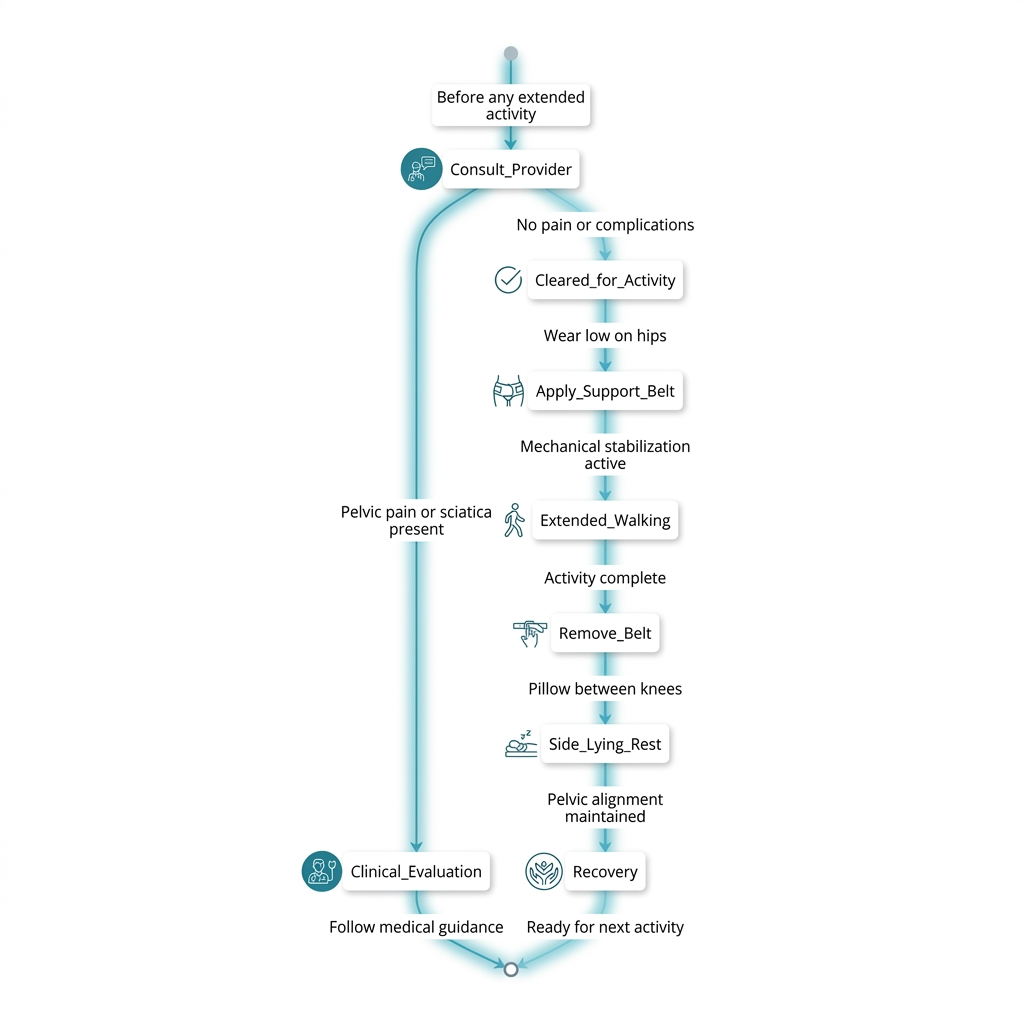
Actionable Preparation and Comfort Tools for Expecting Mothers
Before you do anything, talk to your prenatal healthcare provider. If you’re experiencing any pelvic pain, pubic symphysis discomfort, or sciatica, you need a clinical evaluation before participating in extended walking. The pubic symphysis is the joint at the very front of your pelvis, where your two hip bones meet in the center like the two halves of a wishbone: normally it’s held snug by thick cartilage, but pregnancy hormones soften that cartilage, and the joint can shift or separate slightly under the weight of your growing belly. This is not overcautious. This is basic risk management.
If you’re cleared for activity, the next step is external support. A maternity support belt or SI joint belt can provide the mechanical stabilization your loose ligaments are currently lacking. The 2019 systematic review I mentioned earlier confirms that these garments work by compressing joint spaces and restricting hypermobility. Hypermobile means the joint moves farther than it’s supposed to, like a door hinge that swings past where the doorframe should stop it.
Think of It This Way
Think of a bookshelf mounted to your wall with just two screws instead of four: the shelf is still attached, but every time you set a book on it, the whole thing tilts and wobbles. During pregnancy, hormones soften the ligaments that normally hold your joints snug and stable, the way those extra screws keep the shelf from moving. Your pelvis and spine are still connected, but now they shift more than usual with every step. A support belt works like adding a temporary brace across that wobbly shelf: it doesn’t replace the screws, but it keeps the structure from tilting while you’re loading weight onto it. When you’re done walking and lying down to rest, you take the brace off so the shelf can move freely again, because your body needs that full range of motion when it’s not under load.
Here’s how to wear it correctly: Position the belt low on your hips, just above your pubic bone and below your belly. It should be snug but not restrictive. You should be able to breathe normally and move freely. The belt is not replacing your core muscles. It’s assisting them.
Wear it during the walk. Take it off when you get home. Do not sleep in it. Your body needs to move through its full range of motion when you’re resting.
After the walk, prioritize horizontal rest. Coordinate with your partner to handle post-event cleanup so you can lie down. Use a side-lying position with a supportive pillow between your knees and ankles to keep your pelvis neutral. This is the safest sleeping posture during pregnancy and the most effective position for reducing sacroiliac joint strain.
If you’re experiencing sharp, pinpoint pain that doesn’t resolve with rest, or if you have pain that radiates down your leg or into your pubic symphysis, you need a structural evaluation. That’s not normal muscle fatigue. That’s joint dysfunction.
Prenatal chiropractic care focuses on restoring proper alignment to the pelvis and spine. In my practice, I use a measurement-driven approach that includes a thorough 45-minute initial consultation with detailed physical examinations, orthopedic tests, and clinical history to create individualized care plans. During pregnancy, I rely on hands-on assessment rather than X-rays; routine radiographs are contraindicated due to the risk of ionizing radiation exposure to the developing fetus. I’m not guessing. I’m measuring what I can feel and what your body tells me through movement patterns and palpation.
The Webster technique is a specific chiropractic adjustment that addresses sacroiliac joint dysfunction in pregnant women. It’s gentle, evidence-based, and designed to restore normal biomechanics without forcing the joint. If you’re dealing with persistent SI joint pain, this is the type of care you need.
Is Standing to Hand Out Halloween Candy Bad for Pregnancy Posture?
Standing for extended periods while distributing Halloween candy can strain pregnancy posture, potentially causing joint dysfunction rather than simple muscle fatigue. Pregnant women should watch for unilateral sharp pain, difficulty rolling in bed, or radiating leg pain the following day, as these indicate structural issues requiring professional chiropractic assessment rather than rest alone.
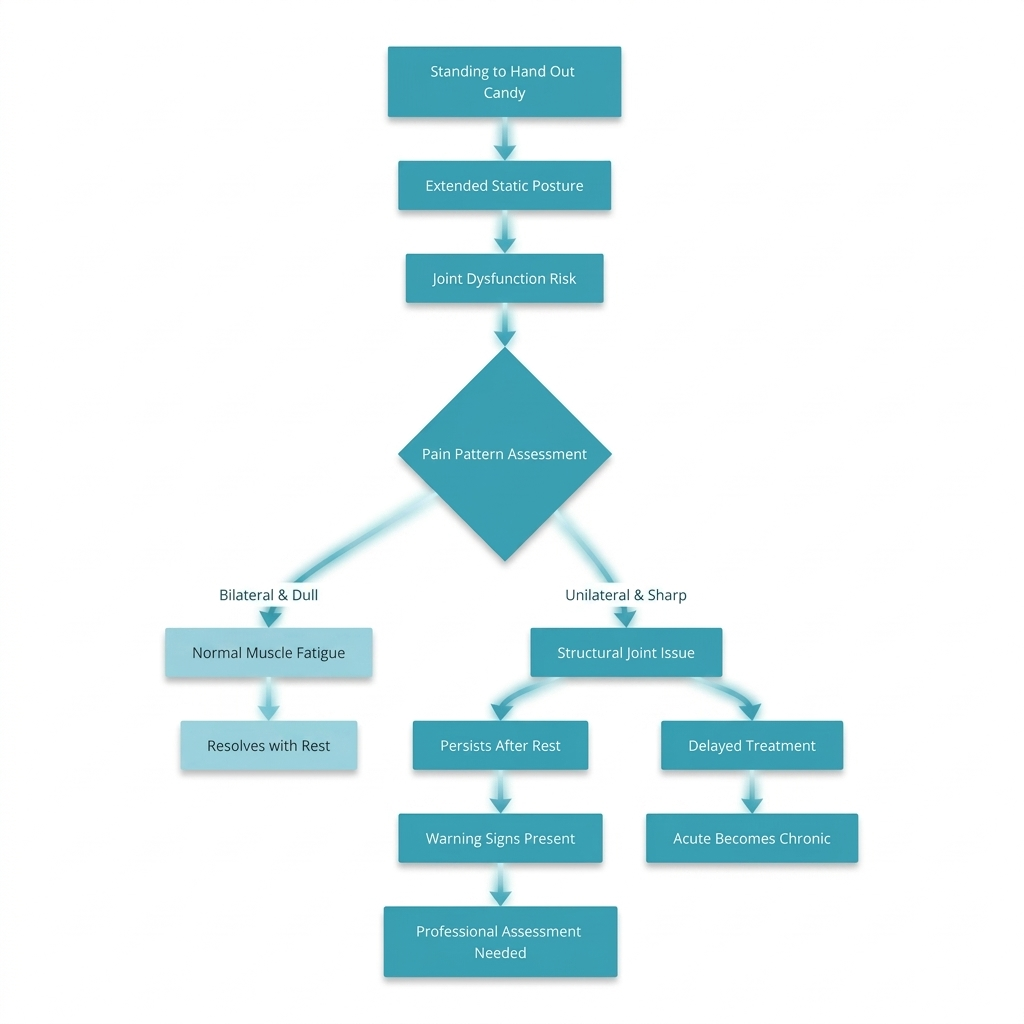
Recognizing When to Seek Professional Care
Normal muscle fatigue is bilateral, dull, and resolves with rest. Joint dysfunction is unilateral, sharp, and persists after rest. Unilateral means on one side only, like when your left shoe pinches but your right foot feels fine.
If you wake up the morning after Halloween and you can’t roll over in bed without sharp pain in your lower back or buttocks, that’s not muscle fatigue. If you have pain when you take a step, that’s not muscle fatigue. If you have pinching in your pubic symphysis or radiating pain down your leg, that’s not muscle fatigue.
Those are signs of structural joint issues that require professional assessment.
Don’t wait for it to get worse. Don’t assume it will resolve on its own. Joint dysfunction doesn’t heal through rest. It heals through proper alignment and stabilization.
At Simon Chiropractic Center, we see this pattern every year. Expecting mothers participate in Halloween. They ignore the early warning signs. They wake up the next day in significant pain. They call us a week later when it hasn’t improved.
The earlier you address joint dysfunction, the faster it resolves. Waiting turns an acute issue into a chronic one.
How Do I Build Sustainable Pregnancy Movement Habits?
Build long-term pregnancy movement habits through consistent daily attention to body mechanics: recognize early joint fatigue signals and rest promptly, distribute weight symmetrically to protect the pelvis, prioritize supportive footwear over appearance, and maintain small preventive adjustments rather than waiting for problems to escalate. Maintenance consistently outperforms reactive interventions throughout pregnancy.
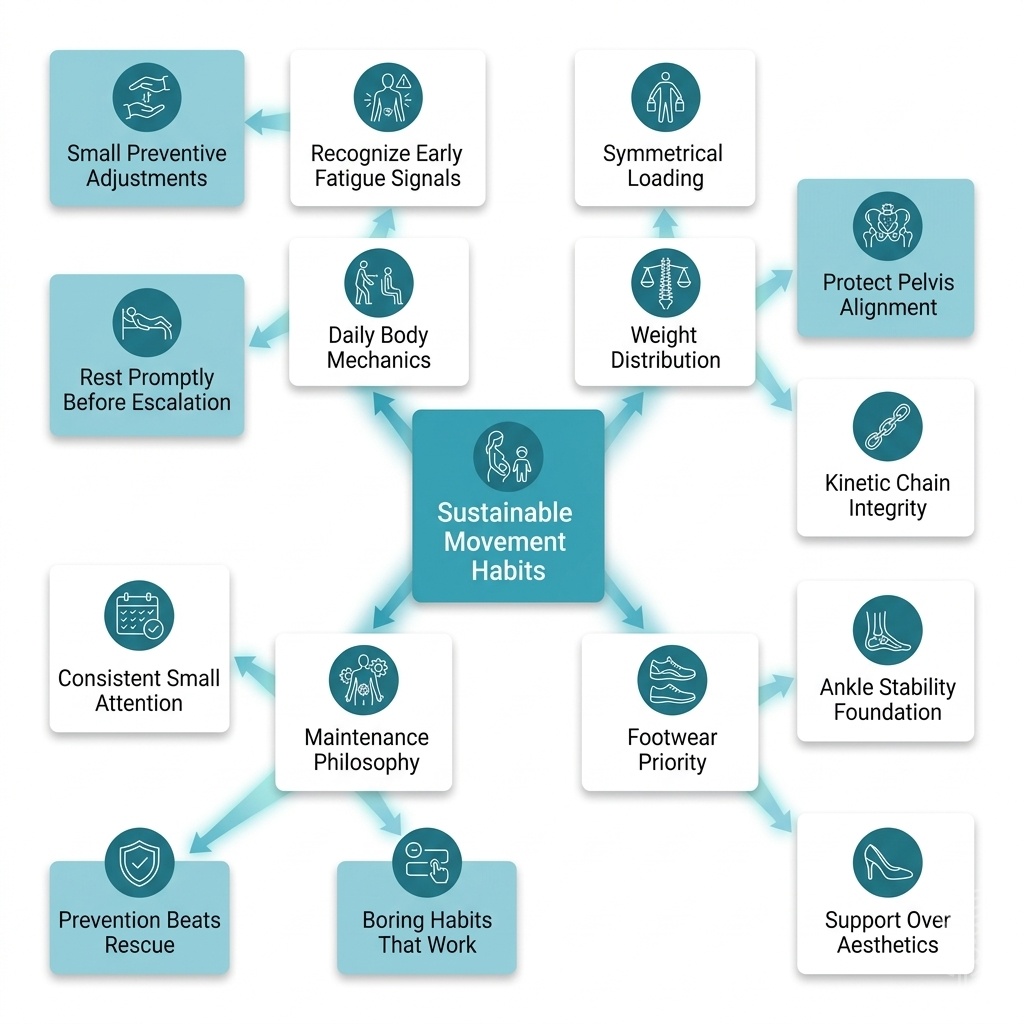
The Long View: Building Sustainable Movement Habits
Halloween is one night. Pregnancy is nine months. The habits you build now will carry you through the rest of your pregnancy and into postpartum recovery.
If you learn to recognize early signs of joint fatigue and respond by resting, you prevent bigger problems. If you learn to distribute weight symmetrically, you protect your pelvis. If you learn to prioritize supportive footwear over aesthetics, you protect your kinetic chain. Your kinetic chain is all the joints stacked from your foot to your hip to your spine, working like linked train cars: when one car tilts or derails, every car behind it has to compensate for the tilt.
These are boring habits. They’re not exciting. They don’t make good social media content. But they work.
Maintenance beats rescue. Every time.
You don’t need a heroic intervention. You need consistent, small, daily attention to how your body is loaded and how it moves. That’s what keeps you functional through pregnancy and beyond.
The Simple Version
Think of a row of dominoes standing on a table: tip the first one and the whole line responds, each piece shifting the angle and balance of the next. Your body’s joints work the same way during pregnancy. When your right ankle rolls inward because your shoe has no arch support, your right knee tracks a little differently. That changed knee angle shifts how your right hip socket receives weight. The hip tilt changes the angle your pelvis sits at. The pelvis angle changes how your low back curves. One joint’s position becomes the starting condition for the joint above it. When you learn to notice early fatigue in your feet and rest before that fatigue travels up the chain, you’re catching the first domino before it tips the rest. That’s why small daily attention to how you stand and walk protects more than just the joint you’re thinking about right now.
Enjoy Halloween. Walk with your family. Hand out candy. Take pictures. Just do it with your eyes open to the biomechanical reality of what your body is managing right now. Biomechanical reality means the physical forces and leverage your joints are actually handling: how much weight, at what angles, and for how long, like a crane operator who needs to know both what the hook is lifting and how far the arm is extended.
And if you wake up the next morning with pain that doesn’t resolve, don’t wait. Contact us. We’ll assess what’s actually happening in your spine and pelvis through careful physical examination, and we’ll build a plan to fix it.
Simon Chiropractic Center
2500 South Power Road, Suite 106
Mesa, AZ 85209
We’re here when you need us.
Article Citations:
- Back Pain During Pregnancy (FAQ115) – American College of Obstetricians and Gynecologists
- Exercise During Pregnancy (FAQ119) – American College of Obstetricians and Gynecologists
- Pelvis: What It Is, Where It Is, Types & Anatomy – Cleveland Clinic
- Overpronation: What It Is, Causes & Treatment – Cleveland Clinic
- Physical Activity for Healthy Pregnant or Postpartum Women – Centers for Disease Control and Prevention
- The Effect of Maternity Support Garments on Alleviation of Pains and Discomforts during Pregnancy: A Systematic Review – PubMed
The information provided on this website is for educational and informational purposes only. It is not intended to be a substitute for professional medical advice, diagnosis, or treatment. Always seek the advice of your physician or another qualified health provider with any questions you may have regarding a medical condition or the health and welfare of your child or yourself during pregnancy.
Never disregard professional medical advice or delay in seeking it because of something you have read on this website. Chiropractic care and wellness recommendations are highly individualized, and results will vary from person to person. The content provided here does not establish a doctor and patient relationship.
If you think you may have a medical emergency, call your doctor, go to the nearest hospital emergency department, or call emergency services immediately. Reliance on any information provided by this website is solely at your own risk.